Add to your simulation program, the simulation of the SDE for Geometric Brownian motion and Vasicek process.
#Code VB.Net
https://drive.google.com/file/d/1H0-ZDydHAcNYE99PgGGagWG48yS0qGPj/view?usp=sharing
The code contains the stochastic processes of the applications:
- 13_A
- where represent the sum of i Bernoulli random variables px(1-p)(1-x) observed at the times j=1, …, i.
- Represent with histogram the distribution of f(i) at different time. (f(i) is the sum of i Bernoulli random variables)
- compute the absolute and relative frequency of the f(i)’s contained in the interval (p-ε, p+ε)
'generate for m paths n points
Public Function Generate_path() As Path
 ...
  for i = 0 to n
      ...
      p = 0.5 ' or a value between 0,1
      Dim v As Double = R.NextDouble
           If v <= p Then
                path.sequence.Add(0)
           else
                path.sequence.Add(1)
      ...
   next
   ...
End Function
- 15_A
- where illustrate the Glivenko-Cantelli theorem
- and create both the histogram and the empirical CDF of the sample mean
Private Sub Timer1_Tick(sender As Object, e As EventArgs) Handles Timer1.Tick
   'Increase m and n for  closer to theor function

    For i = prec_m To m - 1
        listOfPath.Add(Generate_glCantPath(i))
    Next
   ...
    n += 1
    prec_m = m
    m += n
End Sub
' Uniform convergence of empirical CDF to the theoretical convergence
'1/n*(sum of indicator function)
Public Function Generate_glCantPath(m_path As Integer) As Path
...
 For i = 0 To n
        Dim ran As Double = R.NextDouble() * 100
        If ran < v Then
            path.sequence.Add(1)
            path.gl_canMean += 1
        Else
            path.sequence.Add(0)
            path.gl_canMean += 0
        End If


    Next

    path.gl_canMean /= n
...
End function
- 18_A
- where represent Poisson Distribution
- P(i) = P(i-1) + Random step(i), for i = 1, …, n, where Random step(i) is now a Bernoulli random variable with success probability equal to λ * (1/n)
- represent with histogram the distribution of P(i).
- Represent also the distributions of the following quantities (and any other quantity that you think of interest):
- Distance (time elapsed) of individual jumps from the origin
- Distance (time elapsed) between consecutive jumps
'generate for m paths n points
Public Function Generate_path() As Path
 ...
  for i = 1 to n +1
      ...
      Dim prob As Double = path.probability(i - 1)
      p = lambda/n' or a value between 0,1
      Dim v As Double = R.NextDouble
           If v <= p Then
                 path.probability.Add(prob + v)
           else
                 path.probability.Add(prob)
      ...
   next
   ...
End Function
- 20_A
- where represent Brownian Motion
- P(t) = P(t-1) + Random step(t), for t = 1, …, n, where Random step(t) is now: σ * sqrt(1/n) * Z(t), where Z(t) is a N(0,1) random variable
- represent with histogram the distribution of P(t).
'Generate N(0,1)
Public Function Generate_z()
        Dim u1 As Double
        Dim u2 As Double
        Dim s As Double = 1.0

        While s >= 1.0
            u1 = 2.0 * R.NextDouble - 1
            u2 = 2.0 * R.NextDouble - 1
            s = u1 * u1 + u2 * u2
        End While

        Return u1 * Math.Sqrt((-2 * Math.Log(s)) / s)
    End Function
Public Function Generate_pathNormal()
    ...
      For i = 1 To n
            Dim z As Double = Generate_z()
            'Generate Rademacher random variable
            Dim v As Double = R.NextDouble * 2.0 - 1
            Dim rand As Double = (sigma / Math.Sqrt(n) * z)
            If v <= rand Then
               ...
            End if
   ...
End Function
- 23_A
- Geometric Brownian motion
- Vasicek process
https://drive.google.com/file/d/1OXINcmOoxhJx-ptDG324MYrnrg_xfqZx/view?usp=sharing

Collaboration:
Luca Scarmozzino https://stats4cyber.wordpress.com/

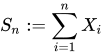 . The stochastic process S := ( Sn ) n ∈ N is known as a random walk.


 Statistics Course