What is a Brownian diffusion process. History, importance, definition and applications.
Brownian motion
A stochastic process, defined on a common probability space
(Ω, Σ, P)
with the following properties:
- Increments must be independent and stationary (Cause is a Lévy process)
- Increments has the N(0,Δt) distribution
- x0 = 0
- Path must be continuous with probability 1 (Almost sure):
P{ω ∈ Ω : X( . , ω) is continuous} = 1
Diffusion Processes
A continuous time stochastic process with(almost surely) continuous sample paths which has the Markov property (the conditional probability distribution of future states of the process depends only upon the present state, not on the sequence of events that preceded it.) is called a diffusion.
The simplest and most fundamental diffusion process is Brownian motion(The independent increments imply the Markov property).
Also called Wiener process, It is one of the best known Lévy processes (càdlàg stochastic processes with stationary independent increments) and occurs frequently in pure and applied mathematics, economics, quantitative finance, evolutionary biology, and physics.
Brownian motion was discovered by the biologist Robert Brown in 1827, who observed through a microscope the random swarming motion of pollen grains in water.
The theory of Brownian motion was developed by Bachelier in his 1900 PhD Thesis and independently by Einstein in his 1905 paper which used Brownian motion to estimate Avogadro’s number and the size of molecules.
Wiener in 1923 proved that there exists a version of BM with continuous paths.
https://en.wikipedia.org/wiki/Markov_property
https://arxiv.org/pdf/1802.09679.pdf
http://dept.stat.lsa.umich.edu/~ionides/620/notes/diffusions.pdf
https://dlib.bc.edu/islandora/object/bc-ir%3A102098/datastream/PDF/view

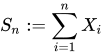 . The stochastic process S := ( Sn ) n ∈ N is known as a random walk.
 Statistics Course